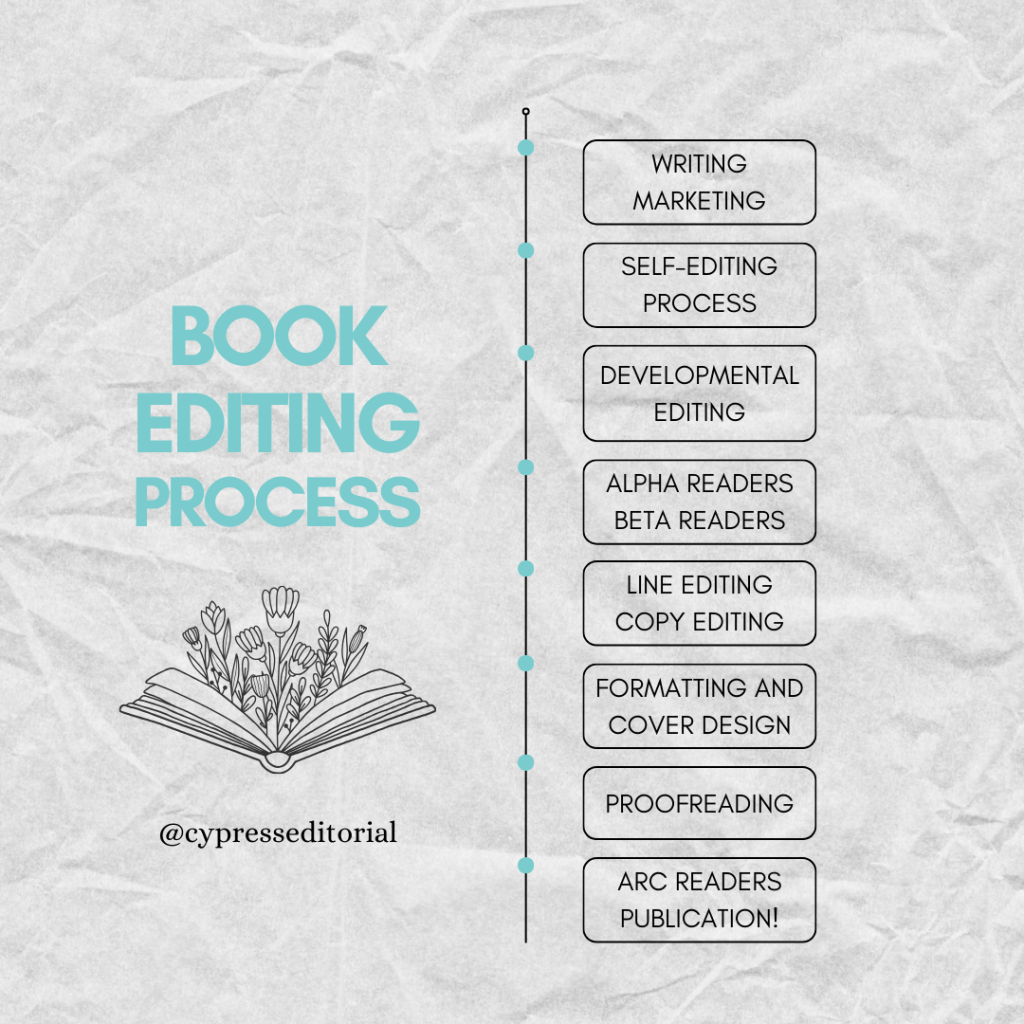
This is a quick timeline detailing the ideal stages for self-publishing writers, though budgets vary and everyone’s journey is unique. Let me know if I can help at any point or connect you with a publishing professional.
- Writing and marketing- This is the time to focus on your craft and the development of your novel. During your writing process, I’d also recommend beginning your marketing efforts to build excitement prior to your novel’s release. I’d also research publication routes (traditional, self-publishing, hybrid) to determine what works best for you.
- Self-editing- Self-edit to the best of your ability before you hire an editor. This saves you time and money in the long run. Still, you should self-edit each time you receive structural feedback from a reader or editor. It’s worth noting that some writers might only hire one type of reader. There’s no perfect formula, but the more eyes on your manuscript, the better.
- Developmental edit- Your editor will provide feedback regarding big-picture elements like pacing and characterization. This is a collaborative stage to help you ensure your novel resonates with readers. You’ll likely want to revise substantially after receiving feedback, as your editor might identify plot holes and more. If you’re looking for an affordable alternative, consider a manuscript evaluation.
- Alpha and beta readers- Typically, alpha readers read an earlier draft, while beta readers come in after more revision has taken place. They’re there to show you how a typical reader would respond and to provide feedback on what confuses and excites them. They can come before or after professional editing depending on your needs, though the former can be helpful cost-wise. While you don’t have to hire every type of reader, the more you invest in the process, the better. That said, it’s worth noting that many of the writers I work with only hire beta readers.
- Line editing and copy editing- Line editing involves style (flow, sentence structure, diction, etc.) while copy editing involves mechanics (error correction, consistency, and accuracy). They’re typically involved in that order but can sometimes be combined.
- Formatting/design and cover design– Now it’s time to find an excellent formatter or typesetter; the former is more common for e-books and simple designs. It’s also important to find a cover designer who can capture the essence of your novel. Some writers might use programs like Atticus or Vellum to format themselves, though I’d hire a designer if you’re writing a children’s book or cookbook with more complex formatting.
- Proofreading- Proofreading is a final check for errors, typically after your book has been formatted for publication. You should complete your own changes prior to this stage.
- ARC readers and publication- You can also hire ARC readers to read a pre-published copy of your work, generate excitement, and provide early reviews. Sometimes ARCs can come before proofreading. Then it’s time to publish your novel!


 Cypress Editorial
Leave a comment